An Architectural Journey from the Past to the Present
- Nazlı Doğa Erdoğan
- 6 Şub
- 6 dakikada okunur

For me, the History of Architecture course was much more than just an introduction to significant buildings or a chronological ranking of movements. This course was a truly eye-opening experience that allowed me to understand how architectural thought and practices have evolved from prehistoric times to the modern age.
The best part of the course was that instead of defining architectural history only through "styles" (such as Gothic Cathedrals or Baroque Palaces) or specific "canons," it examined architectural concepts, themes, and ideas within a chronological flow. Rather than a prescribed "correct" style, I saw what motivated the people of those periods, what needs arose, and how these needs were resolved spatially, structurally, and technically.
Although our main geographical focus was the Near East, the Mediterranean, and Europe, the brief mentions of other architectural cultures allowed us to see the universality of architecture and how it diversified across different geographies. I was fascinated by seeing a wide range of examples, from basic shelter needs to monumental structures, and from small settlements to massive cities. Of course, we hear about many important buildings everywhere, but understanding and feeling why they are important was truly mesmerizing.
After this course, I now much better understand and can recognize what influences today's buildings and why they have certain forms or functions. The needs, technological possibilities, cultural values, and even worldviews of past civilizations have left traces in today's architecture—sometimes lying in the subconscious, sometimes shouting, "I am here!" I have begun to see not just the exterior appearance of a building, but the processes and thoughts that brought it into being.
Most importantly, because I can now "read" buildings, this course gave me the ability to compare them and understand their similarities and differences. Seeing what common points an ancient temple and a modern skyscraper might have in terms of functional or aesthetic aspects—or how similar problems were solved with different solutions in entirely different contexts—was incredibly enlightening.
The architectural vocabulary I gained through this course is an added bonus! I can now use much more conscious and accurate terms when defining a space, a building, or a structure.
In short, for me, this course was far from being a dry historical narrative; it became a tool for understanding the present through the wisdom of the past and imagining the future.
I would also like to share some of the comparisons I made for the course here:
1- Terra Amata - Glass House

Terra Amata is a settlement located in Nice, France, dating from the Lower Paleolithic period, dating between 400,000 and 300,000 BC. Such early structures emerged as a result of the physical threats that shaped human life. The fireplace's central location served as a focal point, providing protection from physical threats and meeting the needs of the time. The structure is quite simple and temporary, with spaces focused on essential needs.
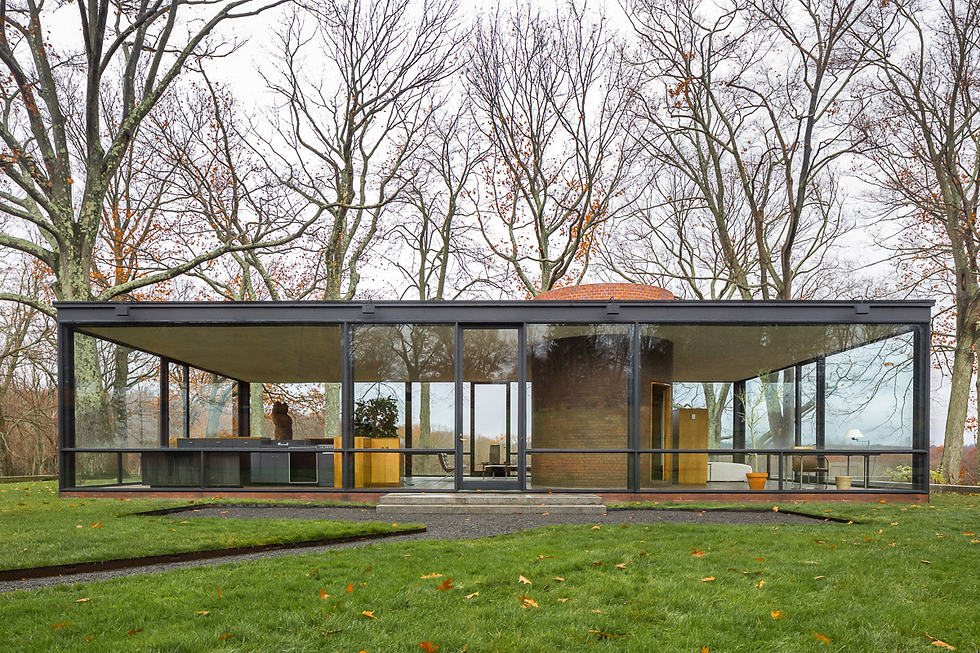
Philip Johnson's Glass House shares a similar focus: the central living space, the hearth, reveals the space. Visible from everywhere, the hearth is the most important element in the structure. However, the material used here allows the space to integrate with nature while also offering a minimalist aesthetic. The space is transparent and open, with social interaction still organized around the center, but presented in a much more visual and experiential way.
The fact that these two structures, built at very different times and with different opportunities, create similar spaces around the hearth demonstrates that this strategy is linked not to time but to humanity.
2- Marsh Arabs - Markhall
Markhall and Marsh Arabs, with their monumental structures, semicircular and elliptical forms and similar light and shadow conditions, are reflections of each other at different times.
3- Temple of Queen Hatshepsut - Fallingwater
While the Temple of Queen Hatshepsut acts as an extension of the cliff beneath it, establishing a connection with nature, Fallingwater's structure balances with nature this by being placed on a rock above the temple. Another similarity is that, despite their different shapes, we can still perceive the layered structure in both.
4- Hanging Gardens of Babylon - La Strada dei Mille Vasi Rossi
Both La Strada dei Mille Vasi Rossi and the Hanging Gardens of Babylon create layered spaces by placing vegetation vertically. Both structures create multi-level gardens where greenery becomes a structural element rather than a decorative element. Their terraces encourage social interaction, treating the built space as a shared experience.
5- Roman domestic villa houses - Rijksmuseum
Although the two courtyards in to the Rijksmuseum and the conecting of the two roads consept are very similar to Roman domestic villa houses, the two streets in the Rijksmuseum connect to the other road by passing through the courtyards, not through the courtyards; So their axes are different. Similarly, vaults can be read in the interior of the building
6- The Athens Agora - The Lawn
The Athens Agora and the University of Virginia's "The Lawn," despite their exterior locations, create essential social focal points for a city and an academy, respectively. While the Agora is an organic public square, emerging from the accumulation of independent structures over time, void emerges spontaneously between the buildings. In contrast, "The Lawn," designed by Thomas Jefferson with a single, rational vision, serves as the primary axis connecting and hierarchizing all the surrounding structures, thus making void the fundamental architectural element that organizes the buildings.
7- Hagia Sophia - the Great Courtyard of the British Museum
Both structures (Hagia Sophia and the Great Courtyard of the British Museum) share the principle of using a circular focus within a square/rectangular outer frame to establish a spatial hierarchy that brings people together. The key difference lies in the organization: in Hagia Sophia, the circle (dome) rises vertically through structure and light, creating a sacred unity and the sole focal point of the interior; in the Great Courtyard, the circle (Reading Hall) stands as a separate object placed horizontally, and the primary gathering space becomes the surrounding square frame. In short, while in Hagia Sophia, the center unifies and encompasses; in the Great Courtyard, the center is framed as a distinct focal object.
8- Lalibela Churches - Chichu Art Museum
Both structures share the same goal of preserving the landscape and creating a sense of introspection by being buried underground; this is the powerful relationship these geometrically formed spaces establish with nature. While the Lalibela Churches (12th century) embody religious symbolism by carving the rock (subtractive) into the earth, the Chichu Art Museum (21st century) conceals reinforced concrete (additive) geometries underground, offering an experience of art and light isolated from the outside world. Both create a simple and monumental architectural language by concealing their masses within the earth.
9- Alhambra - Doha Tower
Both the Muqarnas Dome in the Alhambra and the façade of the Doha Tower employ a complex angular geometry that dematerializes the surface, creating a sense of dematerialization. In the Alhambra, this effect is achieved through the Muqarnas; these cells diffuse light and create shadow play, concealing the weight of the ceiling and simultaneously serving a structural function. In contrast, the Doha Tower employs the same principle in a modern shading layer. The geometric lattice of metal and glass that envelops the tower's exterior, with its repetitive angular modules, blocks out external light and heat. The key difference between the two structures is that the Muqarnas is part of the traditional load-bearing structure, while the Doha Tower's lattice is a non-load-bearing structure focused on climate control.
10- Gaudí - The TWA Flight Center
The TWA Flight Center's fluid, wing-like form was designed, like Gaudí's, using natural principles of load distribution. Eero Saarinen and his team designed the roof's thin reinforced concrete shell structure, resembling the inverted catenary curve of ropes under gravity, based on compressive forces that would transfer loads most efficiently. This method allowed them to capture the structural efficiency of Gothic cathedrals with modern materials and create vast, column-free spans like those of the Gothic cathedral.
11- Grote Markt - Silodam
The shops and merchant houses on Grote Markt, like Silodam, are characterized by the unification of similar yet distinct units on a single facade. The Grote Markt facade is formed through a historical and organic process, with individual and diverse commercial/residential properties juxtaposed. The diversity stems from differences in ownership and use (commercial and residential). In contrast, Silodam, as a result of a modern and planned design, combines 10 different housing types in a single large structure. The diversity here is a programmatic and conscious design decision, and its function is solely residential.
12- Fatih Complex - The Interlace
While the Fatih Complex features repeating domed madrasa units forming courtyards on a horizontal plane, The Interlace extends this modular logic vertically by stacking and cross-arranging massive residential blocks. Both structures create enormous "cities within cities" with their own squares and social amenities through the repetition of units.
13- San Carlo - Jubilee Church
In San Carlo, Borromini reveals the "restless" energy of the Baroque by bending the stone walls like paper, creating those famous concave and convex curves. Richard Meier, in the Jubilee Church, modernizes this movement, transforming it into gigantic concrete sails; it's as if he took Borromini's complex waves, simplified them, and inflated them with the wind. In both, it's impossible to see straight walls; both architects make the rays dance on those curved surfaces, adding incredible dynamism and spiritual depth to the space.
Yorumlar